Friday, March 15, 2013

What Is Abenomics

Everything You Need To Know About 'Abenomics' — The Japanese Economic Experiment That's Captivating The World

Shinzo Abe

AP

There's a new government in Japan, and it appears determined to finally do "whatever it takes" to attempt to revive the moribund Japanese economy, which has struggled with deflation for a decade.

The plan – called "Abenomics," named after newly-elected Prime Minister Shinzō Abe – is three-fold. It involves a massive increase in fiscal stimulus through government spending, a massive increase in monetary stimulus through unconventional central bank policy, and a reform program aimed at making structural improvements to the Japanese economy.

In short, "Abenomics" amounts to one of the biggest economics experiments the modern world has ever seen.

Financial markets are loving it. The Japanese stock market is soaring. But what exactly is it, and how is it expected to work?

In a recent report, titled "Abenomics Handbook," Nomura economists led by Tomo Kinoshita break down the Japanese government's new plan and examine the challenges facing it.

Naturally, the first question is: How exactly are these policies supposed to boost the economy?

While fiscal stimulus and structural reform are essential components of the experiment, monetary policy is expected to do most of the heavy lifting in the short term. So, let's take a look at the monetary policy behind the plan first.

The monetary policy aspect of Abenomics

The goal of easy monetary policy is to reduce real interest rates. In Japan's case, it has a significant side effect of weakening the yen.

So, the yen is weakening – and it's beginning its journey downward from incredibly elevated levels. (In recent years, investors piled into yen as a safe-haven currency, helping to drive up its value.)
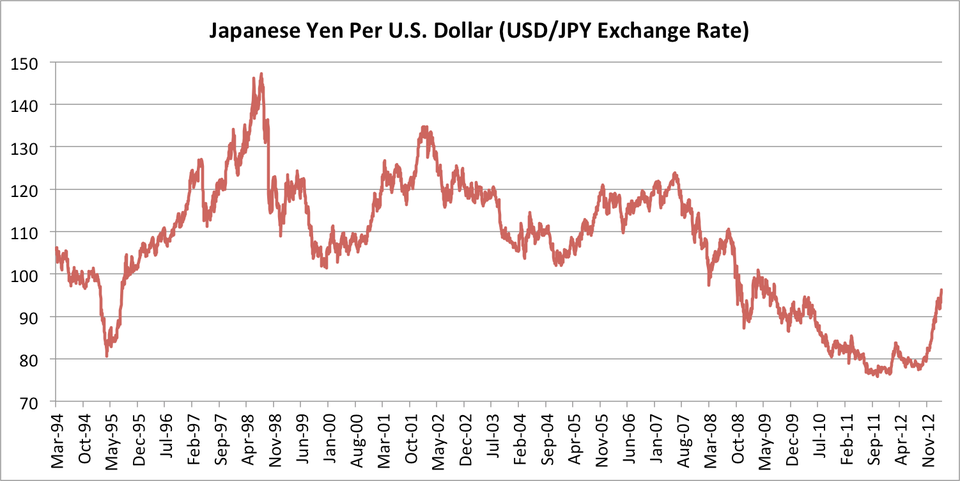
USDJPY dollar-yen exchange rate

Business Insider / Matthew Boesler, data from Bloomberg


A weaker yen could be virtuous for the Japanese economy. The currency has already devalued swiftly against the dollar since September, when the wheels of a new economic regime in Japan were set in motion.

This does a number of things. Most importantly, it boosts exports, because other currencies can now buy more Japanese-manufactured products. That means manufacturers are selling more, which feeds into corporate earnings and hopefully translates to increased business investment.

All of this should boost stock prices on a fundamental basis. At the same time, the weakening yen provides fuel for stocks. Since September, the Japanese government has verbally "talked down" the yen, and a big rally in the Nikkei materialized along with the decline of the currency.

"As for the specific effect of higher share prices on the economy," the Nomura team writes, "we think higher share prices invigorate corporate capex by (1) making it easier for companies to raise funds, and (2) making companies more likely to invest in business expansion. We estimate that a 10 percent rise in share prices boosts capex by 3.2 percentage points one year later."

And the wealth effect is a big part of the plan.
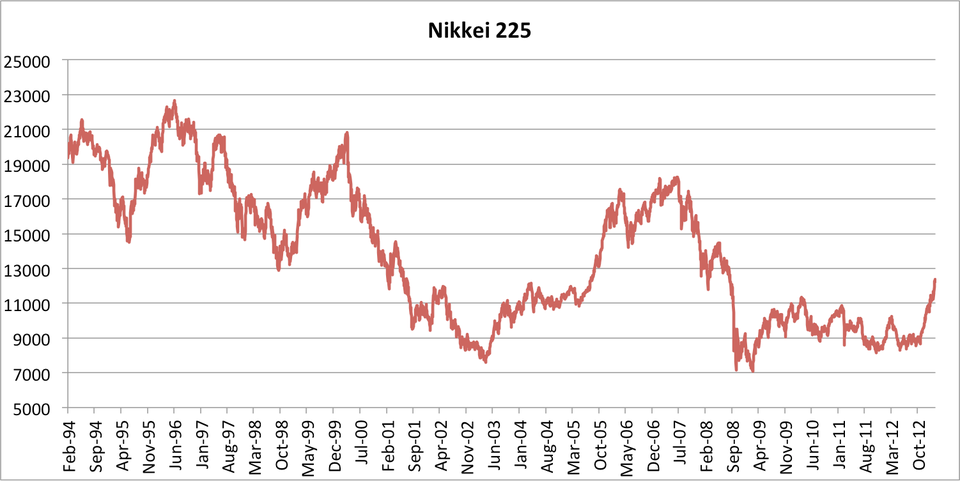
Nikkei 225

Matthew Boesler / Business Insider, data from Bloomberg


‹"For households, we think higher share prices stimulate willingness to spend by boosting the value of shareholdings and giving an indication of the health of the economy," the Nomura economists continue. "We estimate that a 10 percent rise in share prices boosts consumer spending by 0.12 percentage points three months later."

All of this works to narrow the ¥16.5 trillion (~ $170 billion) gap between current GDP and potential GDP, thus working toward eliminating deflationary pressures.

However, the Japanese government has come under fire in the international community recently for its verbal interventions in the yen that have caused it to swiftly devalue against other currencies.

The Bank of Japan has a few other options.

Recently, it announced that it would double its target inflation rate to 2 percent, employing open-ended asset purchases (much like the Federal Reserve is doing in the United States) to get there.

This represents a shift from the conservatism that has characterized the Bank of Japan in recent years. Haruhiko Kuroda, a big dove on monetary policy (meaning he's usually in favor of more stimulus, not less), is set to take over at the helm of the central bank in April. The times are changing, and one can expect to see some experimentation in the months and years ahead.

(Click here for 23 things the Bank of Japan could do to weaken the yen even more.)

The Abenomics approach to fiscal policy

The second part of the "Abenomics" game plan involves short-term fiscal stimulus. This aims to revive economic growth immediately through increased government consumption and public works investment.

Abe already introduced ¥5.3 trillion (~ $60 billion) in public works spending as part of its 2013 budget. That's up from an estimated ¥5 trillion (~ $50 billion) last year, according to Nomura, representing a change from the fiscal tightening that Japan has undergone in recent years.

"‹Aside from the general account, the government plans to set aside spending for post-quake reconstruction efforts in special accounts," says Nomura. "The Abe government has decided to boost total spending on the five-year effort (through FY15) to about ¥25 trillion (~ $260 billion), from ¥19 trillion (~ $200 billion) previously."

The important point here is that the government is pledging to be flexible with regard to fiscal policy in the coming years, a stance in stark contrast to those in the United States (which is dealing with the effects of sequestration) and the euro area (where economic austerity is helping to deepen the economic contraction there).

Structural reforms – the most important aspect of Abenomics

Loose fiscal and monetary policy is supposed to facilitate expansionary economic conditions in the short term (although weakening the yen is arguably a longer-term goal as well).

Crucially, though, the success of "Abenomics" hinges on the third prong of the approach: structural reform.

The Nomura economists call this "the key to improving medium-term growth potential," details of which are expected to be unveiled to the public in June.

"With government debt having expanded to more than 200 percent of GDP, we think it will be difficult for Japan to boost the economy in the medium term via fiscal spending alone," they write. "As the effects of bold monetary easing are primarily transmitted via expectations on the financial and capital markets, any resultant move out of deflation is likely to be short lived unless economic growth can also be boosted via the government's growth strategy."

Below is a summary of the growth strategy currently under proposal.

Key themes proposed by the Headquarters for Japan's Economic Revitalization

Nomura, based on Headquarters for Japan's Economic Revitalization data


There are several aspects to the regulatory reforms under proposal as well, outlined below.

Main areas of focus for regulatory reform panel

Nomura, based on regulatory reform panel (within Cabinet Office) data

In short, there is a lot of work to do.

Will the Abe government be able to get it all done? There are some serious open questions about its ability to achieve success in putting the Japanese economy back on stronger footing.

Why Abenomics might not work

The first question is whether the Bank of Japan will be able to implement monetary policy to actually effect 2 percent inflation. After all, they've been operating with a 1 percent inflation target, and they haven't even been able to come close to that.

The Nomura economists write, "While we think attainment of the 2 percent inflation target will be problematic, we see the establishment of the 2 percent inflation target as meaningful because setting the bar high and bringing on board more powerful easing measures makes an end to deflation more likely."

Nomura also acknowledges the risks to financial stability that may arise from excessive monetary easing, warning that "if the BOJ were to sharply increase its purchases of financial assets, this could cause distortions in the markets for those financial assets, disrupting market mechanisms or producing unforeseen risks related to the accumulation of imbalances.

In other words, there could be bubble trouble.

The Abe government's fiscal approach is tricky, too. Good policy strives to be counter-cyclical, meaning that when the economy improves, the government should take the opportunity to tighten its belt.

There's a consumption tax hike scheduled for 2014, though. Nomura thinks the Abe government will boost spending to offset it.
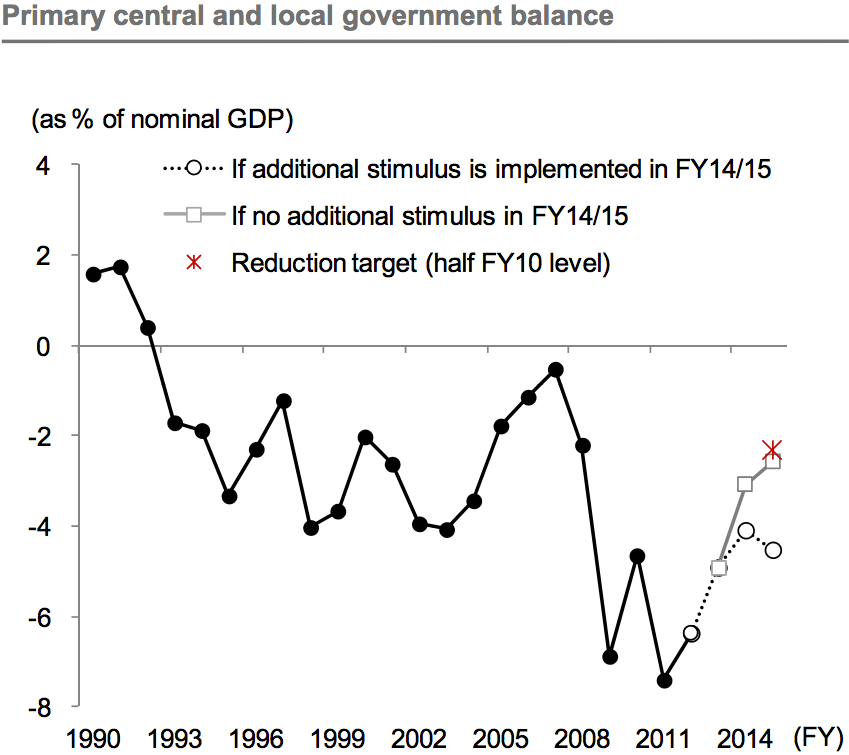
Japan primary central and local government budget balances

Nomura

Click to enlarge

"The biggest challenge," the economists say, "is striking a balance with fiscal reconstruction." Abe's government says it wants to cut the budget deficit in half from 2010 levels by 2015 and flip the budget balance into outright surplus by 2020. Continued public spending could make that pretty difficult.

Finally, if the yen stops weakening, it really puts the brakes on the entire "Abenomics" project. The yen is expected to continue its decline – and many expect the U.S. dollar to enter a new bull market – but, as ever, the future is uncertain, and for Japan, it depends on implementation.

We should also note that this all assumes that the Abe government is committed to the task to begin with. There is at least one theory that ultimately calls this commitment into question. (Everybody Is Talking About The Japanese Yen's Collapse, But Nobody Understands The Prime Minister's True Motivations.)

The Nomura economists come to the following conclusion:

Yen depreciation benefits exporters but it could also have an adverse effect on the economy via an expansion of the trade deficit or a deterioration in the terms of trade (export prices/import prices). Also, the benefits of fiscal expansion and monetary easing are not limitless. In particular, fiscal and monetary easing are not limitless. In particular, fiscal expansion could stimulate market concerns regarding problems securing funding and fiscal risk.

For Japan's economy to overcome these challenges and be revived, we think the key requirements are a change in ingrained expectations about deflation (ie, an improvement in growth expectations), a self-sustaining increase in private-sector economic activity (ie, growth without fiscal expansion), and fiscal reconstruction (ie easing of fiscal risk). If companies can pass higher import prices and other cost increases onto selling prices, we think restructuring pressures in Japan will lessen. If confidence in economic growth in Japan grows simultaneously with an improvement in Japan grows simultaneously with an improvement in corporate earnings, we think increases in employment and wages will be likely.

If real wages increase amid efforts to end deflation and put inflation on track, we think the Japanese economy will be more likely to return to self-sustaining growth.

The rest of the world will be watching closely.
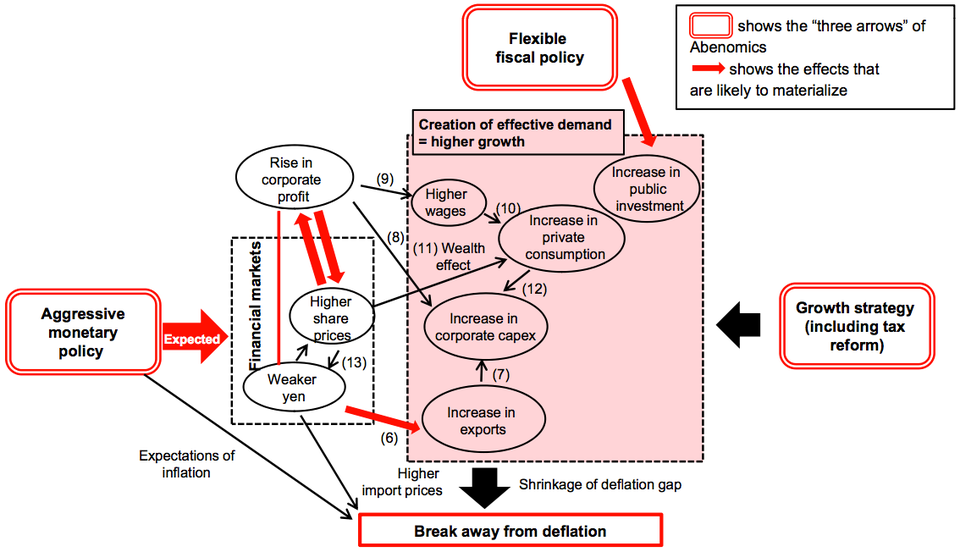
Abenomics flow chart

Nomura

Click to enlarge


Goay Joe Lie
Director of Joe Lie Beauty And Cosmetics

Morning Markets March 15 - Business Insider

Markets Around The World Are Rallying Again...

All around the world, stocks just keep rallying.

Currently US futures are up, so the Dow could be looking at an 11-day winning streak.

Europe is up a tad.

Japan had another big night, with the Nikkei hitting a 4 and a half year high. The index added 1.45%, which is actually a fairly modest rally by recent standards, since 2% days have been pretty common.

There's some important data in the US coming out today, including CPI and U-Mich sentiment.


Goay Joe Lie
Director of Joe Lie Beauty And Cosmetics

Michelle Obama's Second Vogue Cover Released


Michelle Obama's Second Vogue Cover Released

130314-mobama-vogue-cover

Michelle Obama's much-anticipated Vogue cover was released Thursday, featuring the first lady in a blue Reed Krakoff dress as was previously reported. The image, shot by celebrity photographer Annie Leibovitz and styled by Vogue fashion director Tonne Goodman, marks Obama's second main stage Vogue appearance. She last fronted the magazine in March 2009. 

Leibovitz's cover imagery is part of a miniature portfolio that appears inside the magazine. It's there the FLOTUS poses with President Barack Obama in the same Krakoff design, giving her husband a warm embrace in a stately White House room. Another image features the First Lady in a pensive pose, wearing a black Michael Kors sweater and ball skirt. The shoot's entire wardrobe was reportedly pulled from Obama's own closet.


Goay Joe Lie
Director of Joe Lie Beauty And Cosmetics

Wednesday, March 13, 2013

MARKETS ARE LOWER AROUND THE WORLD

Markets Are Lower Around The World

shopping carts

Polycart via flickr

Markets are generally lower around the world.

China fell 0.99% in its session.

Japan registered its second straight down day, falling 0.6%.

In Europe, Italy is off 0.44%.

US futures are basically flat.

The big story of the day that will be coming up will be the retail sales report out in February, which should give us one of our first clean looks at the consumer now that the Payroll Tax Holiday has ended.

That report comes out at 8:30 AM ET.

He Also the Democrats unveil their budget today.


Goay Joe Lie
Director of Joe Lie Beauty And Cosmetics

Monday, February 18, 2013

How Cyberstalking Affects Victims | TechNewsDaily.com

How Cyberstalking Affects Victims


CREDIT: Shutterstock: Mark Antonino
View full size image

The Internet may seem removed from real life, but for stalking victims, it can seem even more dangerous.

Victims of cyberstalking suffer more fear and take more actions to protect themselves over time than those who are stalked in the physical world, according to a study published in Justice Quarterly, a journal for law enforcement and legislators.

The research was based on the 2006 Supplemental Victimization Survey from the National Crime Victimization Survey (the most current data available). As of the end of last year, all states have laws  that address cyberstalking, cyberharassment or both. (In legal circles, cyberstalking usually includes a threat of harm, while cyberharassment does not.) Sanctions for those found guilty of cyberstalking range from misdemeanors to felonies.

Online harassment and threats cause more fear among victims than real-life stalking and prompt more "protective measures," such as switching email  accounts and locking down or even closing their Facebook and other social media accounts, the researchers found. It also winds up costing victims more than twice as much, Matt Nobles, a researcher from Sam Houston State University in Texas, said in a statement. He partnered with colleagues at Weber State University, Arizona State University and the University of Cincinnati for the study.

Women are more likely to be stalked in everyday life, but they make up a smaller percentage of online victims — 70 percent versus 58 percent. The average age of female victims was higher than might be expected, averaging around 38 years old for online victims and just over 40 for offline victims.

While both groups of victims reacted to harassment and threats with fear and self-protective measures, a larger proportion of cyberstalking victims took time off from work, quit their jobs, dropped out of school or avoided family and friends.

The changes didn't come cheap. Costs, including legal fees, child care costs and moving expenses averaged $1,200 for a cyberstalking victim, compared with $500 for traditional stalking victims.

Over time, people who have been stalked in their own environs returned to their normal living patterns, but cyberstalking victims continued to add self-protective measures. The researchers suggested that a stalking episode may provoke an immediate reaction for many victims, while the cyberstalking  condition tends to build and become more severe over time.

However, continued protections may have more to do with the ubiquity of the Internet and less to do with psychological effects. Disappearing from the digital world can be more difficult to do than leaving town. See also: 5 Steps to Digitally Disappear .


Goay Joe Lie
Director of Joe Lie Beauty And Cosmetics

Monday, February 11, 2013

How Poor Leaders Become Good Leaders

HBR Blog Network

In our previous blog, Bad Leaders Can Change Their Spots, we described a group of 71 leaders who were able to elevate their leadership effectiveness from the 23rd percentile to the 56th percentile — that is, from being poor leaders to good ones. While many readers were impressed that it could happen, many more were curious (and even doubtful) about how it could happen. Admittedly, not every leader can do this. But all 71 of these individuals (who represented three-quarters of the entire group of poor leaders in this study) did accomplish this seemingly Herculean shift. How?

Using 360-degree feedback data over a 12- to 18-month period, we were able to track what, exactly, the leaders who'd made the most significant progress were doing. We found that practically all of them (more than 80%) significantly improved their ability to executive nine particular leadership skills.

  1. They improved their communication effectiveness. This was the most common skill that these people improved. Communication skills are highly malleable. For many of these leaders, improvement here was less about learning new skills than about using the skills they already had more often and with more people. (When we talk to groups of leaders and ask, "Who here communicates too much?" we see very few hands rise.) We have also found that when struggling leaders spend time improving presentation skills, the effort can produce an immediately payoff.
  2. They made an effort to share their knowledge and expertise more widely. Poor leaders tend to be stingy with information and know-how. By sharing their knowledge more frequently and teaching people what they know how to do they can simultaneously impress and develop their direct reports.
  3. They began to encourage others to do more and to be better. Some leaders believe that if they minimize challenges to their team and expect less of their people, subordinates will see them as better leaders. This is wrong! Fewer challenges is the opposite of what a work group or organization needs. When leaders challenge their direct reports to do more and be better they thought they could be, the leaders are actually perceived to be better themselves.
  4. They developed a broader perspective. It's easy for leaders to become preoccupied with work demands and internal politics and become oblivious to what's happening in the outside world. Getting leaders to stop and look at the bigger picture can help them see potential problems sooner and focus more on strategic and less on tactical issues. This leads to constructive change and innovation.
  5. They recognized that they were role models and needed to set a good example. It frequently happens that leaders unintentionally (or unknowingly) ask others to do things they don't do themselves. This never works. Many of our 71 leaders were surprised to discover that they were perceived as hypocritical. They learned to walk their talk (or at least to "stumble the mumble").
  6. They began to champion their team's new ideas. Many of our 71 leaders were also surprised to learn that their teams considered them to be the "Abominable NO man (or woman)." When they shifted from discouraging new proposals to encouraging and supporting innovative ideas and thinking, positive changes occurred.
  7. They learned to recognize when change was needed. More generally, our successful leaders were those who learned to willingly support and embrace change, and encourage others to do so, as well. How? Essentially, by becoming more proactive — that is, by doing a better job of spotting new trends, opportunities, and potential problems early.
  8. They improved their ability to inspire and motivate others. Practically all of the actions we've already mentioned create a more inspirational environment. In addition, there were two notable things these leaders did to inspire others. First, they did a better job keeping people focused on the highest priority goals and objectives. Second, they made a special effort to stay in touch with the concerns and problems of their teams. When a leader is the last to know that an employee is having difficulties, others interpret that as a lack of concern. Providing support and assistance to an employee in difficult circumstances not only helps that employee, but also reassures others they can expect to receive the same treatment.
  9. They began to encourage cooperation rather than competition. Many leaders come out of school believing that work is a zero-sum game that creates winners and losers, and so they compete, in an effort to get ahead. Battles are costly and consume a great deal of resources. In the long run, internal competition causes every participant to lose. When leaders look for ways to encourage cooperation and generate common goals, they become more successful.
As you review this list of what our bad leaders did to improve, we believe you'll agree that what we are describing are common virtues that had not been practiced commonly enough. Our data show that taking these steps are especially effective in increasing the success of leaders who've been formerly regarded as poor, but they can improve all leaders. To us, that means that everyone — bad leaders, average leaders, and even good leaders — can change their spots. So, what's holding you back?


Goay Joe Lie
Director of Joe Lie Beauty And Cosmetics